Small genes, big changes: scientists reveal how minimal mutations can transform the evolution of lizards
A Bridge Between Rapid Changes and Millennial Transformations
For decades, biologists have wondered if the small genetic variations accumulated over a few generations are sufficient to explain the large evolutionary leaps that give rise to new species. Now, an international team of scientists from Australia, Vietnam, and Germany has just provided a convincing answer: yes, and they have demonstrated it with a mathematical model that connects rapid evolutionary processes with those that occur over millions of years.
The Challenge: Uniting Microevolution and Macroevolution
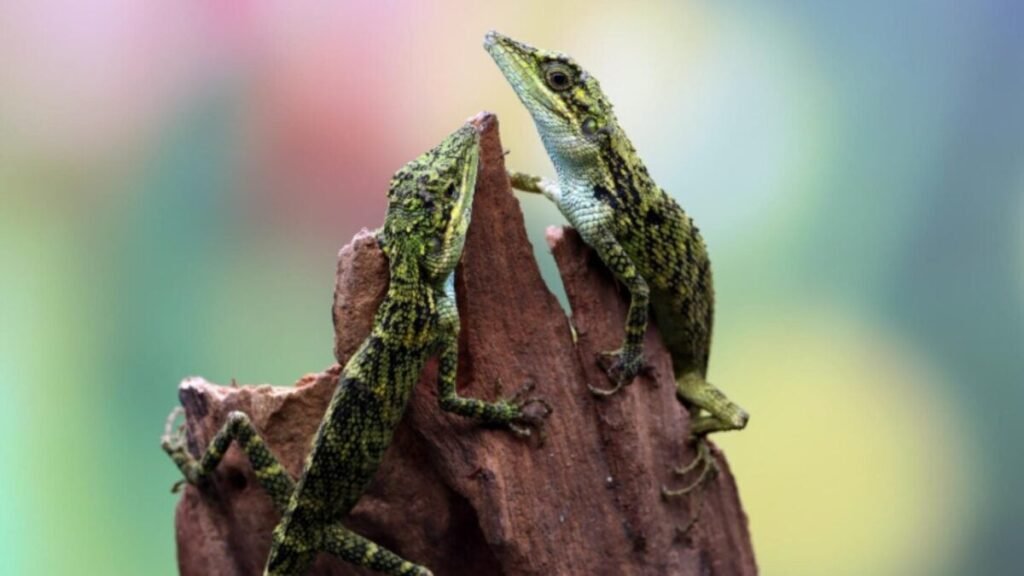
Led by Dr. Simone Blomberg from the University of Queensland, the team started from a classic question: can small inherited changes explain the appearance of new species? Until now, the available mathematical tools could not integrate both evolutionary levels. To solve this, the researchers developed a model that combines short-term evolutionary processes with long-term transformation (macroevolution). The method allows tracking how traits—such as leg length, skull size, or jaw shape—evolve within a species and between different species of Anolis over time.

The Key: An Isopectral Model That Preserves Genetic Variation
The new model, called “isopectral,” was tested with data from seven species of Anolis lizards. The researchers gathered genetic and morphological information on eight different traits and then simulated their evolution over thousands of generations. Unlike other approaches like the Ornstein-Uhlenbeck model or the Brownian model, the isopectral model showed that the direction of genetic changes can vary over time, but the total amount of heritable variation remains constant. This suggests that evolution is not simply random drift: it is guided by a dynamic balance between innovation and conservation.
The study not only provides a mathematical tool, but also an integrative view of biological change. In a context where molecular biology and artificial intelligence provide increasingly precise data, this approach could become the foundation for.
Anolis lizards, with their surprising diversity, remind us once again that the secrets of evolution are hidden in the tiniest details: a mutation, a change in color, or a slightly longer leg can, over time, transform the course of natural history.