
Creatures from the Deep Sea: They’re Basically Aliens
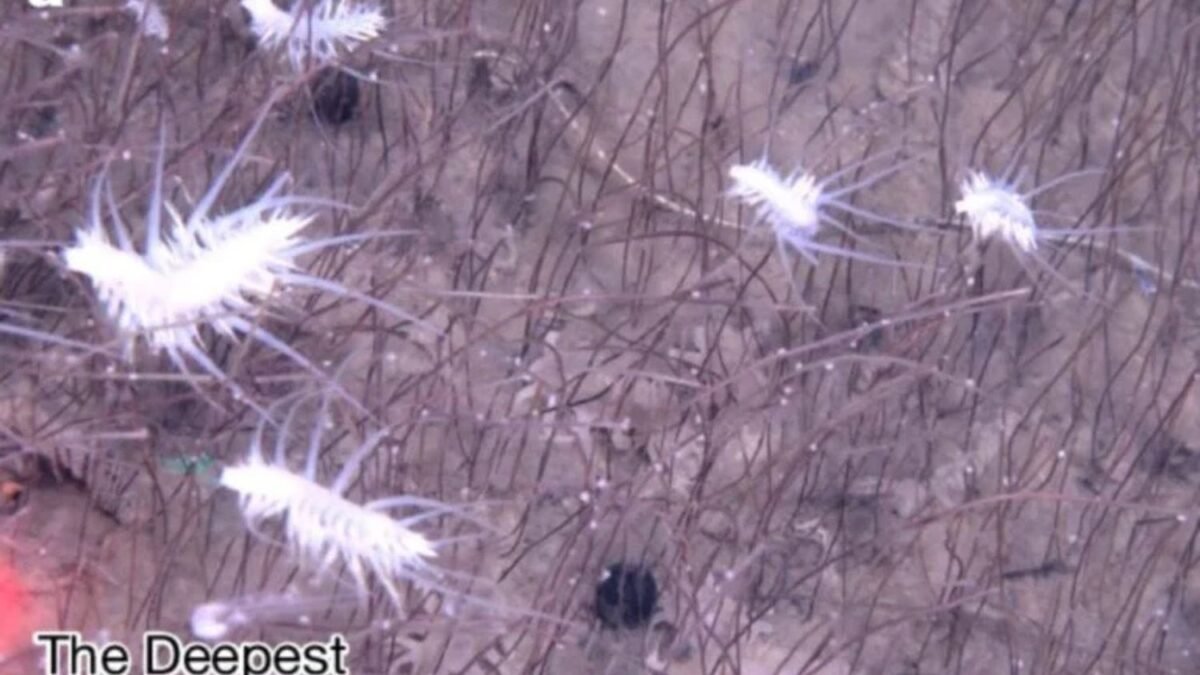
At a depth of about ten kilometers in the northwest of the Pacific Ocean, researchers explored the bottom of two submarine trenches. They discovered flourishing communities of marine creatures living in chemosynthesis. This type of community had never been discovered before, especially at such depths.
Unprecedented Findings
The unprecedented findings were published on Wednesday, July 30th. There are photos and videos of the strangest organisms living in two of the planet’s most inhospitable ecosystems. The light does not reach the bottom of the Kuril-Kamchatka or Aleutian trenches. These organisms survive by converting chemicals into energy, instead of using food or sunlight. Scientists have long believed that there are many chemosynthetic communities in hadal trenches, but their visualization has always been challenging.
Exploring Harsh Environments
Hadal trenches are depressions on the seabed that can measure between 6,000 and 11,000 meters in depth. They form in subduction zones where the edge of one tectonic plate has slid beneath another. The Kuril-Kamchatka Trench reaches a depth of 9,600 meters and extends from a point off the coast of Hokkaido, Japan to its intersection with the Aleutian Trench near the Commander Islands of Russia. The Aleutian Trench is slightly shallower, at around 8,000 meters, but much longer, extending from its intersection with the Kuril-Kamchatka Trench to the Gulf of Alaska.
Between July and August of 2024, Peng and his colleagues conducted a series of explorations aboard a manned submersible called Fendouzhe. This underwater vehicle can reach the deepest parts of the ocean, nearly 11,000 meters. At the bottom of the trenches, they discovered communities that thrive on chemosynthesis, related to abundant methane seepage from cracks in the seabed emitting methane gas into the water.
These communities were dominated by marine polychaete worms known as siboglinid polychaetes and mollusks called bivalves, which synthesize energy from fluids rich in hydrogen sulfide and methane. The communities extended over more than 2,500 kilometers at depths ranging from 5,800 to 9,533 meters.
The discovery contradicts the conventional view of hadal ecosystems being sustained by organic material settling from the ocean’s surface. This study shows that hadal ecosystems are characteristic of hadal trenches, hosting large populations of species that rely on chemosynthesis.
“As more chemosynthetic hadal communities are discovered, we may uncover undocumented species and previously unknown interactions between animals and microorganisms that have evolved under the high-pressure conditions of the hadal zone,” Nature reports.