One million euros paid for forgotten violin linked to Einstein’s contemplation of relativity.
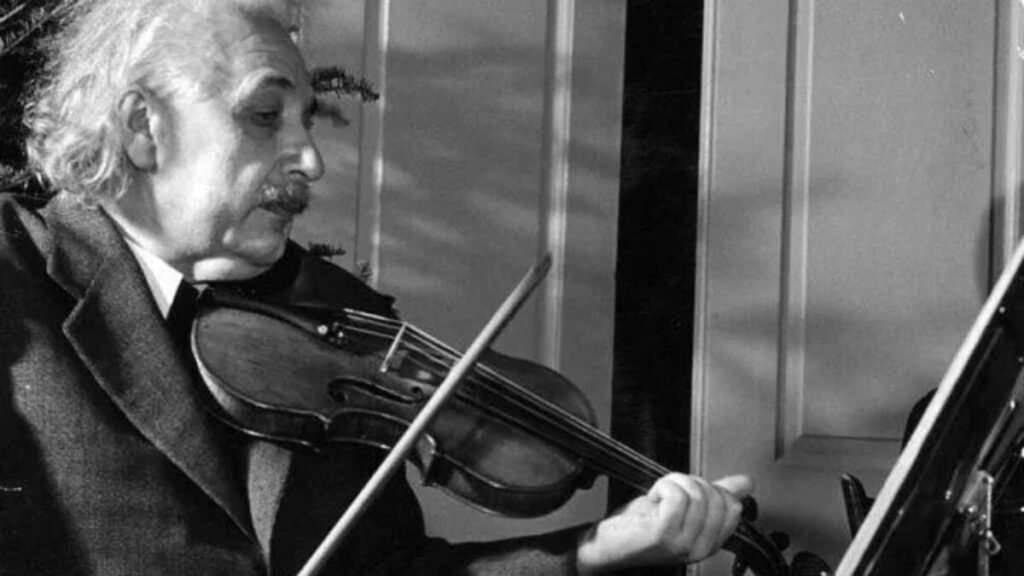
For more than seventy years, a violin rested silently in a German home, with no one suspecting its history. Its sound had accompanied the man who changed our understanding of the universe, but nobody outside the family knew. Until an auction in the United Kingdom brought it back to light, revealing that the instrument had belonged to none other than Einstein. At one million euros, a price that set a world record: the highest price ever paid for an instrument that did not belong to a professional musician. Only violins from the Titanic or those made by Stradivarius have reached higher prices.
The music that ordered the chaos
, began playing the violin as a child, encouraged by his mother, Pauline Koch. At first, he detested it. But something changed when he first heard Mozart. That discovery was almost a revelation: he understood that music also had an internal logic, an emotional mathematics that fascinated him.
Over time, the violin became an essential part of his life. He played in quartets, improvised at meetings with colleagues, and claimed that the notes helped him think better. “Life without music is inconceivable,” he wrote in a letter. For , playing was a way to clear the mind and find hidden patterns, which he would later translate into equations.
The violin from the years of relativity
The instrument now being auctioned was made in 1894 by the German luthier Anton Zunterer. According to experts, bought it with his own money when he was just fifteen years old. It accompanied him during his youth and in the most productive years of his scientific career, including those in which he formulated the theory of relativity.
When in 1932 the physicist was preparing to flee Germany due to the rise of Nazism, he decided to give it to his friend and colleague Max von Laue, another Nobel Prize winner in Physics. Von Laue, in turn, gave it in 1952 to Margarete Hommrich, an admirer of , who kept the violin with great care. The instrument remained in her family for three generations until her great-granddaughter decided to auction it.
A story that resurfaces from letters and records
Authenticating the violin was a task of scientific patience. The composer and musicologist Paul Wingfield, an expert in the musical life of , spent six months tracing its origin. He reviewed letters, customs records, shipping documents, and photographs. In the end, his conclusion was clear: “As sure as anyone could be of something like this: this violin belonged to Albert Einstein.”
The decisive detail was a small inscription on the back: the word “Lina,” a diminutive of “violina.” Einstein gave that name to all his violins. A custom that made them as personal as his notebooks.
A symbol of human genius
The violin is valuable not only because it belonged to , but for what it represents. It is the bridge between science and art, between the precision of formulas and the emotion of sound. The physicist himself used to say that many of his ideas were born while playing, at that frontier where the mind and music merge.
Its sale not only redefines the value of a historical object but also reminds us of something that always knew: that beauty and curiosity, in any form, are drivers of knowledge.
Today, that violin no longer belongs to silence. Its history, rescued from dust and wood, resonates once again like a melody from the past. One that, in some way, continues to speak to us about the universe.